
Media Contact
Katy Payne she/her
360-764-0201
“We’re leaving a whole group of children behind,” says Ferndale School District Superintendent Dr. Kristi Dominguez about the Governor and state Legislature’s decision to cut funding for the Transition to Kindergarten (TK) program by 25% last spring.
Dominguez created Washington’s first TK program back in 2013 while serving as the Early Learning Coordinator for Bellingham Public Schools. At the time, Dominguez heard from local families that they didn’t qualify for Head Start or the Early Childhood Education and Assistance Program (ECEAP) and couldn’t afford private preschool. “It was just closed door, closed door, closed door,” said Dominguez.
Washington ranks 33rd nationally in preschool access for 4-year-olds, with only 24% of children participating in a state-funded preschool program. Limited availability and the cost of private preschool leave many families without an affordable early learning option.
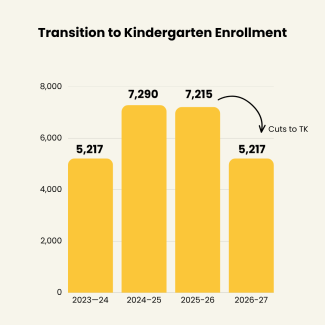
TK helps address the need for more high-quality, affordable preschool. The program is open to children who are at least 4 years old by August 31 and have been identified through a screening process as needing additional support before starting kindergarten. More than 7,200 students participated in the program statewide in the 2025–26 school year. Program enrollment is now capped at just over 5,200 for the coming school year due to reduced state funding.
Early Learning’s Importance
Close to 15,000 people live in Ferndale, a city located about 20 minutes south of the U.S.– Canada border. Ferndale isn’t isolated, but it is rural. “We do have childcare centers, but options are limited in the county,” said Dominguez. “Families have to travel into Bellingham, which sounds like a really easy thing to do, but what about those families who don’t have transportation or the means to get there?"
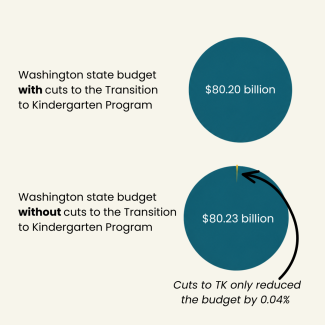
Ferndale School District lost more than one-third of its state-funded TK slots due to the Governor’s and Legislature’s cuts. Of the 157 school districts across that state that offer TK programs, 54 will see a 25% or greater reduction in availability to serve students. “The reduction in TK funding had almost no impact on the larger state budget. I can’t wrap my head around it,” said Dominguez.
Early learning includes all areas of a child’s learning and development from birth to age 9. During these years, the brain grows rapidly, building the foundation for future learning, behavior, and emotional regulation. Supportive early learning environments, at home and in the classroom, help children build the skills they need to learn, connect with others, manage emotions, and stay engaged in school. These experiences are linked to stronger developmental and learning outcomes, including growth in reading, math, social-emotional skills, school attendance, and overall well-being.
The benefits to children are well documented, as is the impact on the broader education system. “There’s research that shows for every dollar you spend on a high-quality early learning program, you get a nine to thirteen-dollar return on investment,” said Dominguez. “Early learning is literally one of the most powerful investments we can make.”
For districts like Ferndale, the concern extends beyond the loss of preschool seats. State data show that children who participate in TK are more likely to enter kindergarten demonstrating readiness across multiple developmental domains measured by the Washington Kindergarten Inventory of Developing Skills (WaKIDS).
In Washington, kindergarten teachers are required to use WaKIDS to observe children's development during the first weeks of kindergarten. Rather than serving as a test, WaKIDS helps teachers understand children's strengths and learning needs across six developmental domains: social-emotional, physical, language, cognitive, literacy, and mathematics. The results suggest that access to high-quality early learning experiences, including TK, can make a meaningful difference. In the fall of 2025, 64% of former TK students demonstrated readiness across all six domains, compared to 54% of non-TK students. “WaKIDS is a measure of who’s had access to high-quality early learning programming,” said Dominguez.
Expanding Access
Dominguez developed the idea for a TK program in Bellingham after hearing a story on National Public Radio (NPR) about Oklahoma school districts that used funding to enroll 4-year-olds in kindergarten. She pitched the idea to the Bellingham superintendent and other local leaders. “We built the program from the ground up,” said Dominguez.
The program started slowly—the first class of students participated in TK for 10 weeks. Soon, Dominguez heard from school districts in other parts of the state that were interested in starting their own programs. “We talked about how TK has to be developmentally appropriate,” said Dominguez. “It has to be grounded in play-based learning and strategies that are good for a 4- and 5-year-old.”
A lot can happen between when a student first attends school and when they graduate. Individual experiences vary, and it’s hard to know the impact of a single factor on a student’s education. Still, it’s worth noting that the TK program Dominguez started in Bellingham served more than 1,200 students during her tenure. “Only 8 of those 1,200 students left needing an IEP (Individualized Education Program),” she said. “That’s unheard of. These were children who had very limited exposure to school of any kind.”
While many factors influence whether a child receives an IEP, she believes the program's early intervention and developmentally appropriate instruction helped many children build skills before entering kindergarten.
Dominguez’s work with TK led to meetings with the Office of Superintendent of Public Instruction and State Superintendent Chris Reykdal to expand access to TK in school districts across the state. Over time, the Bellingham program became one of the models that informed Washington's statewide Transition to Kindergarten program. The agency first published guidance on TK for school districts and charter schools in 2019.
TK helps address one of Washington’s greatest early learning challenges: not enough high-quality preschool opportunities to meet the needs of children and families. By expanding access, serving children from diverse socioeconomic backgrounds, and complementing other publicly funded preschool programs, TK broadens opportunities for children before they enter kindergarten. “It’s part of a mixed delivery system in this state,” said Dominguez. “It’s not the program; it’s a program amongst the other early learning programs in Washington.”
The way Dominguez sees it, the different programs all work to provide as many kids as possible with quality preschool. “It shouldn’t be a competition,” she said. “There’s just so much need. As a state, we’re not even serving close to half of our state’s 4-year-olds.”