
Whole Child Initiative
Need Help?
To ensure that every student thrives and realizes their full potential, OSPI's Whole Child initiative ensures students feel safe, healthy, engaged, supported, and challenged.
The whole child initiative recognizes that access to safe, welcoming learning environments, as well as school supports and community services, is crucial for students' educational and life outcomes.
OSPI is working to coordinate a statewide system that helps every school create the conditions where students are welcomed and supported to learn. We do this by aligning resources, strengthening partnerships, building local capacity, and providing practical tools that help districts improve outcomes for all students. There are four key levers foundational to this effort, including: community & family engagement, foundational, schoolwide supports, systems to ensure students receive additional supports when then need them, and shared data to keep everyone informed of what is happening.
-
Lever 1: Community and Family Engagement
-
LEVER 1: Community and Family Engagement is a critical component of a school system, not outside of it. Schools can strengthen this by connecting students, families, and community groups to school efforts, listening to which environmental factors most support them, and using that feedback to shape decisions.
Learning Guide & Online Modules
Online learning modules and an accompanying resource toolkit to support team discussions and action planning.
- Introduction Module: Authentic Family & Community Engagement
- School Leader Toolkit
- Learning Module Playlist
Family Fact Sheets
Resources to support schools in providing families with data from reputable sources, action items & conversation starters, and links to additional resources.
Behavior After Break
Safety at Home
Social Media Safety
Staff Wellness
Youth Mental Health
Youth Social Connectedness
Youth Substance Abuse -
Lever 2: Foundational Supports
-
LEVER 2: Foundational Supports are necessary to strengthen the everyday experiences all students need to thrive. Strong schoolwide practices, such as relationship-building routines, advisory, clear expectations, transition supports, and inclusionary practices, are key to supporting every student. It also means aligning funding, staffing, and time toward prevention, so schools are not only responding after student needs intensify.
Positive Behavior Supports for Resilient & Inclusive Schools manual is designed for anyone working to create safe and supportive school environments.
The Positive Behavior Supports for Resilient & Inclusive Schools manual is for a wide variety of audiences. District leaders can use it to guide system-wide planning and policy development, while principals and school administrators can apply its strategies to strengthen school-level practices. Teachers, counselors, and support staff will find practical tools to use in classrooms and daily interactions with students. Families and community partners may also reference the manual to better understand approaches that prioritize student well-being and equity.
- Restraint and Isolation Harms Students, Families, and School Staff
- How to Use This Guide
- Section 1: Understanding Positive and Trauma-Informed Behavior Support
- Section 2: School & District Systems That Support Social, Emotional, & Behavioral Well-Being
- Section 3: Classroom Practices For Safe and Inclusive Learning
- Section 4: Effective Support for Students with Extensive Behavior Learning Needs
- Section 5: Considerations for Students With Disabilities
- Section 6: Crisis Prevention and De-Escalation
- Legal Notice
Student Support Programming resources are offered through various topic-specific OSPI webpages.
- Behavioral Health - Mental, Social, & Behavioral Health
- Attendance, Chronic Absenteeism, & Truancy
- School Safety Center
- Multi-Tiered System of Supports (MTSS)
- School Climate
- Family Engagement - Parent & Family Engagement Best Practices
- Homeless Education - Students Experiencing Homelessness
- Foster Care
- Institutional Education
- Social Emotional Learning (SEL)
- Substance Use Prevention & Intervention
- Youth Engagement
- Behavior and Discipline
- Migrant Education Program
- Multilingual Education Program
- Dual Language Education and Resource
-
Lever 3: Systems of Support
-
Lever 3: Systems of Support requires aligning the teams, people, and structures already doing the work. Leaders can begin by mapping current student support teams, identifying overlaps or gaps, and creating a coordinated MTSS or student support structure so support moves from conversation to action. MTSS Components and Resources
The Washington Integrated Student Supports Protocol Implementation is a school-based approach to promoting the success of all students by coordinating academic and nonacademic supports to reduce barriers to academic achievement. RCW 28A.300.139.
Team Driven Shared Leadership
- Structured Meeting Agendas
- National Center for Intensive Intervention Teams Graphic
- TIPS Framework 1/8: Team-Initiated Problem Solving (TIPS) Overview
- Powerless to Powerful
Data-Based Decision-Making
- Positive Behavioral Interventions and Supports Implementation Blueprint: PBIS District Systems Fidelity Inventory (DSFI)
- SWPBIS Tiered Fidelity Inventory Version 2.1
Continuum of Supports
Instruction and intervention are delivered along a continuum to meet the full spectrum of social, emotional, behavioral, and academic needs of all students.
Tier 1 is the foundation for all students and should meet the needs of approximately 80% of the student population. Every student should have equitable access to universal instruction and supports that are:
- research-based and aligned to grade-level standards
- culturally and linguistically responsive
- universally designed (universally designed guidelines), and
- differentiated to meet their unique needs
When more than 20% of students need additional support, leadership teams should re-examine the tier 1 supports in place, as it is an indication that tier 1 instruction and supports may be insufficient. Targeted enrichment and interventions are added to accelerate learning and to remove barriers that prevent students from benefiting fully from universal instruction and supports.
Tier 2 supports are an additional layer of targeted, evidence-based intervention programs that include:
- clearly defined entrance and exit criteria regular progress monitoring to assess response to intervention
- explicit instruction with increased opportunities to practice and receive specific, frequent feedback
- gradual release of control and support when students master skills, and
- increased communication with families to ensure consistency of support in school and at home
(Anderson and Borgmeier, 2010; Newcomer, Freeman, and Barrett, 2013).
Tier 3 supports are an additional layer of intensive, evidence-based intervention programs that have been individualized to meet the needs of students who demonstrate significant risk or do not respond to tier 2 interventions. Interventions may be intensified by strength, dosage, and comprehensiveness.
Evidence-Based Practices - To increase instructional impact, it is important that activities, strategies, or interventions that have been proven to improve student outcomes.
- Evidence-based practices- How to find and select an evidence-based practice
- National Implementation Research Network The Hexagon: An Exploration Tool
- University of North Carolina Hexagon Tool Modules
Cascading District and School Systems
Each system player has a unique role in who is supported and how the support is provided.
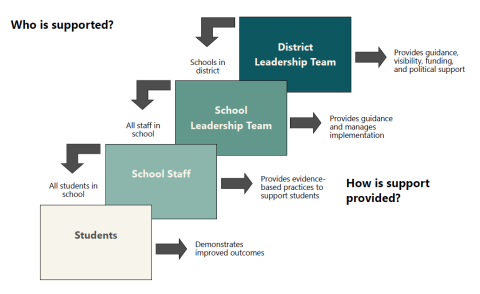
Implementation of MTSS is coordinated through cascading systems (Active Implementation Hub's Implementation Teams). While implementation is often a focus at the school or classroom level, the district’s role is critical. The district leadership team is responsible for ensuring key stakeholders are engaged and systems, resources, policies, and practices are aligned to implementation priorities. The district also ensures that coaching, training, and evaluation capacity are developed across the system.
With support from the district, school leadership teams are responsible for leading MTSS implementation in their school. They oversee implementation, assess implementation, and coordinate communication across internal and external teams to continually improve implementation. School staff implement evidence-based programs and practices through a tiered delivery system to meet the social, emotional, behavioral, and academic needs of students. When implemented with fidelity, students benefit from supports and demonstrate improved social, emotional, behavioral, and academic outcomes.
Implementation Stages
Teams implement systems of support MTSS in stages to build organizational commitment and capacity so students benefit from evidence-based practices and improved outcomes are sustained.
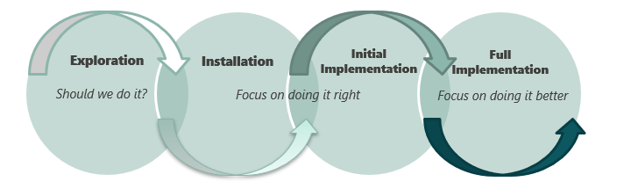
The National Implementation Research Network (2013) identified four stages of the implementation process: Exploration, installation, initial implementation, and full implementation. Implementation stages identify specific activities, outcomes, and unique challenges associated with the implementation process. These stages help in the planning, communication, resource allocation, and evaluation of district-wide MTSS.
During the Exploration stage, implementation leadership teams take time to review their resources and system needs and make informed decisions. When considering the adoption of new programs or practices, teams reflect on the evidence, usability, and supports necessary to implement as well as the need for the program or practice, how well it fits with existing priorities and efforts, and their capacity to implement as intended.
Upon determining intent to adopt new practices or programs, teams begin setting up the infrastructure that will be necessary to implement as intended. This Installation stage includes developing and securing the necessary support, creating feedback loops, ensuring data systems are in place to allow for data-based decision making, and ensuring financial and human resources are in place. The Exploration and Installation stages of implementation are often referred to as readiness to implement. Implementation is likely to take longer, face greater opposition, or fail altogether when teams skip over the exploration or installation stages and try to move directly into implementation.
Initial Implementation is when the practice is beginning to be put into place, but it is not yet a comfortable or fluent practice. During this stage, challenges emerge and sites may consider abandoning the new practice, particularly since it is too early to realize the benefit to students. During initial implementation, it is important to leverage data systems and feedback loops to engage in continuous improvement cycles and communicate swiftly to celebrate successes and address barriers.
As sites reach Full Implementation, practices are now integrated into the environment in a manner that is a new way of operating. Full implementation is often the point at which the practices have been implemented well and long enough to begin showing student benefit (National Implementation Research Network, 2013). Sustainability is an essential focus of implementation. While student outcomes are being realized during full implementation, it’s critical that teams continue to maintain their focus and attention on ensuring sustainability. Changes in resources, staff turnover, and changing needs of students and staff need to be attended to, ensuring systems are flexible and responsive enough to meet the needs of every student.
-
Lever 4: Shared Data
-
LEVER 4: Shared Data means looking at the full student experience together.
This starts with a small set of shared indicators, such as attendance, behavior, academics, wellness, and disproportionality, so teams can see patterns earlier, strengthen prevention, and respond with greater clarity.- Washington State Report Card: A resource to share information about our K–12 schools with parents, educators, families, community members, and students to ensure they have information to engage at the local level.
- Healthy Youth Survey (HYS): A statewide, collaborative effort surveying students on their thoughts, feelings, and behaviors pertaining to a variety of health and safety topics, including school climate and community safety. Results from the survey are located on the Healthy Youth Survey website.
- School Health Profiles: A survey for middle and high school Principals and Lead Health Teachers to assess the status of health and wellness-related policies, procedures, instruction, and environments. Schools across Washington state were randomly selected to participate in the survey every two years. School Health Profiles were last collected in Washington in 2024.