




Annual State Technology Survey
Contact Information
Technology Survey Overview
The Educational Technology Data Collection document explains that OSPI annually collects essential information about technology infrastructure, cybersecurity, emerging technologies, instructional needs, mobile devices and mobile device policies, and EdTech classroom assessments. These are used to meet several legislative requirements and guide the efforts of OSPI’s EdTech team. This collection is due May 31, 2026.
The survey is also used to prepare several legislative reports about classroom-based educational technology assessments (RCW 28A.655.075), technology initiatives (RCW 28A.650.070) and recently passed legislation focused on mobile devices (SB 5346).
It is encouraged that Technology Directors discuss these educational technology classroom-based assessment questions with Teaching and Learning staff before submitting responses.
2025–26 Technology Survey
The survey was directly emailed to district Technology Directors across the state for all public, public charter and tribal compact school districts in April 2026. Data analysis included all results collected up to June 22, 2026.
2025–2026 EdTech Survey: Highlights at a Glance
A Quick Reference for Washington School Districts & IT Directors
Survey snapshot: 271 of 295 districts responded (91.9% response rate); 263 submitted complete responses. Results reflect 94 urban, 76 rural and 1 uncategorized district reported at the district level. Use these highlights to benchmark your district's devices, funding outlook, and AI readiness against statewide peers.
At a Glance
| Metric | Value |
|---|---|
| Total student devices statewide | 1,087,715 (district self-reported totals) |
| Devices in 1:1 programs (coverage) | 89.6% (calculated by self-reported numbers over district reported student population from OSPI data) |
| Dominant operating system | Chrome OS (82% of fleet) (district reported) |
| Devices needing replacement by 2030 | 860,761 (79%) (district reported values) |
| Average funding concern (1–5 scale, 1 highest) | 56% of districts rated it as either their #1 or #2 priority. |
| District AI implementation | 12.9% implementing a policy 10.4% enhancing existing policy 27% not started on policy development 38% exploring policy implementation |
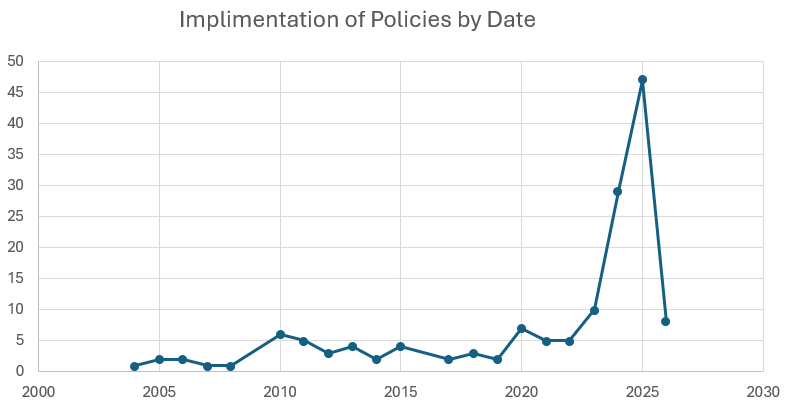
| District mobile device policies | 59% adopted with a policy in place at district or school site 27% reported that school sites set their own policies 12% currently in draft or under development 2% report no policy in place |
Device Replacement Outlook (2026–2030)
Statewide districts' estimate 860,761 devices (about 79% of devices deployed) will need to be replaced within four years.
Device Replacement Projections
| Grade Band | 2026–27 | 2027–28 | 2028–29 | 2029–30 | 4-Year Total |
|---|---|---|---|---|---|
| Elementary | 101,796 | 79,699 | 105,692 | 79,257 | 366,444 |
| Middle School | 54,415 | 54,433 | 63,238 | 54,110 | 226,196 |
| High School | 71,309 | 67,162 | 69,298 | 60,352 | 268,121 |
| All Grades | 227,520 | 201,294 | 238,228 | 193,719 | 860,761 |
Top Challenges Districts Reported
Funding remains the most significant challenge districts reported across both technology needs and AI readiness. Many of the other top concerns are closely connected to funding capacity. For example, outdated devices require replacement funding, while AI implementation depends on funding resources for safe solutions and professional learning.
| Rank | Technology Challenge | AI Challenge |
|---|---|---|
| #1 | Sustainable funding | Funding for safe AI solutions |
| #2 | Outdated devices | Lack of district-level AI policies |
| #3 | Lack of adequate support staff | Lack of PD for educators |
Urban vs. Rural at a Glance
Statewide totals mask significant differences in enrollment, geography, and local resources between urban and rural districts. Yet when device access is measured on a per-student basis, many rural districts have achieved 1:1 student device programs comparable to those in larger urban systems. For district technology leaders, this highlights an important reality: the progress made over the last several years was enabled in large part by targeted investments rather than local or state funding capacity alone.
Federal relief programs, including ESSER (Elementary and Secondary School Emergency Relief Fund) and the Emergency Connectivity Fund (ECF), provided districts with critical one-time resources to acquire student devices and expand digital access during the pandemic. OSPI's Digital Equity grant programs complemented these efforts by prioritizing support for rural and underserved districts, helping many districts establish or expand 1:1 programs and address long-standing access gaps.
The challenge now is sustainability. Both the federal pandemic relief funding and Washington's dedicated state funding for digital equity initiatives have ended. As districts move beyond the initial device deployment phase, they must absorb the ongoing costs of replacement cycles, technical support, software licensing, and infrastructure upgrades within existing budgets. This creates a particular concern for rural districts, where local funding capacity is often more limited.
Without dedicated state or federal investments, districts may increasingly rely on local technology levies to sustain 1:1 programs. Because the ability to generate local revenue varies significantly across communities, there is a risk that the gains made in device equity over the past several years could erode over time. For technology directors, the key question is no longer how to achieve 1:1 access, but how to maintain it as temporary funding sources disappear and replacement costs come due.
Typical 1:1 coverage is essentially the same as urban districts when looking at the self-reported data. Based on Free and Reduced Priced Lunch (FRPL) data, rural districts serve a higher-poverty population on average information from October 1, 2025 CEDARS extract pulled March 31, 2026.
Source available at: School Apportionment
| Metric | Urban Districts | Rural Districts | What it shows |
|---|---|---|---|
| Survey respondent/districts analyzed | 94 | 175 | Rural districts make up almost twice as many of the responding districts as urban districts, so district-level results may more heavily reflect rural district perspectives. However, urban districts serve more students and account for a much larger share of total devices. For example, 175 rural districts reported 181,980 1:1 devices, while 94 urban districts reported 792,230 1:1 devices. |
| Total 1:1 devices, all grades | 792,230 | 181,980 | Urban districts hold far more devices in raw totals, reflecting scale rather than reflecting access. |
| Median 1:1 devices per student | 0.99 | 0.98 | Typical per-student access is nearly identical across locales. Self-reported total devices divided by reported student population. Many rural districts achieved 1:1 access through Emergency Connectivity Funding (ECF) funding but now face a funding cliff, with local funding challenges threatening sustainability. For most WA State districts, ECF funding was awarded prior to 2023. |
| Average FRPL rate | 45.7% | 50.6% | Rural districts serve a higher-poverty student population. |
Key finding: Device equity is essentially even statewide when measured per student. Rural districts have higher average FRPL rates than urban districts, but median 1:1 device coverage is nearly the same. The most important difference is scale: urban districts account for the majority of total devices because they enroll more students, while rural districts represent a larger number of districts with smaller enrollments.
Mobile Device Policy
While many districts are moving quickly to manage personal cell phones and mobile devices during the school day, Only 2% of reporting districts don’t have any mobile device policy in place. The statewide figures below reflect responding districts and can serve as a baseline as your district adopts or refines its own policy. The increase in districts having policies correlates with Superintendent Reykdal’s challenge to districts to have a device policy in place for the 2025-26 school year.
Message from State Superintendent Chris Reykdal
| Mobile Device Policy Measure | Statewide (Responding Districts) |
|---|---|
| Have adopted a mobile device policy | 58% |
| Implemented districtwide | 43% |
| Implementation varies by school | 15% |
| Drafted / under development | 12% |
| No Policy in place | 2% |
| District Policies in place: | % Reported |
|---|---|
| Prohibit personal devices during instructional hours | 71% |
| Use "off and away" storage (kept in backpack/pocket) | 83% |
Report decreased instructional disruptions 57% Report increased student engagement 50% Not yet tracking impact metrics 38%
The most common implementation barriers districts cite are inconsistent enforcement across staff and student resistance. The top supports districts say would help are:
- Model policy language and procedures
- Staff training on consistent enforcement
- Family engagement templates
AI Adoption & Readiness
AI adoption, training and implementation is still early and uneven across districts. Readiness varies sharply depending on whether you look at district leadership, policy implementation, or classroom integration. The table below shows where responding districts place themselves in the implementation stages.
AI policy work remains largely in the planning stage, while classroom implementation is growing more gradually. Among responding districts:
| Maturity Stage |
District Leadership |
Policy Implementation | Classroom Integration |
|---|---|---|---|
| Not started | 10% | 28% | 20% |
| Exploring | 38% | 0% | 47% |
| Planning | 30% | 49% | 10% |
| Implementing | 16% | 13% | 12% |
| Enhancing | 6% | 10% | 12% |
Priorities differ by locale and size: urban districts rank "funding for safe AI solutions" as their top AI challenge, while rural districts rank "lack of district-level AI policies" highest. Similarly, smaller districts most need policy guidance, whereas larger districts most need funding. The widest urban–rural gap is over concern or resistance to AI in the classroom.
Note: Percentages are the share of responding districts and are rounded; columns may not total 100%. "Implementing AI" is self-defined so readiness figures reflect district perceptions rather than a verified standard.
Key Findings
- Funding is the #1 concern across every area. Funding is the top concern across every area. Sustainable funding is a near-universal challenge, and most other concerns are driven by the lack of available funding.
- Device numbers are strong but aging. Nearly 1.09 million devices serve students and 89.6% of those are considered 1:1 devices, but an estimated 860,000 devices (79% of the current devices deployed) will need replacement within four years.
- AI implementation is in early stages and reliant on funding. Many districts are still exploring AI in the classroom with concerns around usage and how to fund professional development and implementation.
- Rural and urban districts report similar rates of 1:1 device access, but those statewide figures mask important differences in sustainability. Many Washington districts relied on federal Emergency Connectivity Fund (ECF) dollars during the pandemic to establish or expand 1:1 device programs. As those devices reach end of life, all districts face replacement costs, but rural districts often have more limited local funding and staffing capacity and fewer economies of scale, making it more difficult to sustain and refresh devices at the same rate as larger urban districts.
- Mobile device policy adoption is accelerating. Fifty-eight percent of responding districts have adopted a mobile device policy, including 43% with districtwide implementation and 15% where implementation varies by school site. The dominant approach to enforcement is “off and away” storage is the primary policy of 83% of districts surveyed, and 71% of those districts prohibit personal mobile devices during instructional hours. Districts report early positive outcomes, including decreased instructional disruptions (57%) and increased student engagement (50%). Enforcement consistency and student resistance are the top implementation barriers to mobile device policy enforcement.
- Source
-
Source: OSPI Annual Educational Technology Survey 2025-2026, OSPI (271 responding districts), and OSPI 2025–26 Educational. Figures are self-reported and generally represent the share of responding districts, not of all students or all 295 districts. Device counts and replacement plans reflect district-reported estimates; 25 districts were flagged for data anomalies regarding total device counts. Mobile device outcome findings should be framed as district-reported perceptions, as 38% of districts are not yet tracking impact metrics. Free and Reduced Price Lunch(FRPL) and district student counts 2026-27 FINAL Free and Reduced Price Lunch (FRPL) Information cross referenced the data collected in this survey.
- Survey Questions
2024–25 Technology Survey
295 (91%) of eligible public entities (public charter, tribal compact, and public) school districts responded to our 2024–25 annual technology survey. That is an increase of 28 responses from last year, with 267 responses.
Internet Connectivity
- 276 districts are connected to Washington's K-20 Education Network, including 5 new procured sites this year.
- 75% of district respondents have s Wide Area Network (WAN).
Guest Access
- 93% of district respondents allow guests to connect to a district network.
- 80% of districts reported guests only connect to a separate guest network.
- 59 districts replied they only provide guest access only if requested or must-have. 59 Districts replied they only provide guests network access if it is requested or must-have.
- 59 Districts replied they only provide network access if it is requested or must-have.
Instructional Devices
- There is an estimated total of 1,010,686 1:1 devices deployed to students across all K-12. (Learning devices that are assigned to individual students).
- There is an estimated total of 1,096,359 non 1:1 devices deployed across all K-12
- (Learning devices that are not individually assigned).
- NEW Info: The dominance of Chrome OS devices suggests strong adoption of Chromebooks in schools.
| Operating System | Average Percentage (%) |
|---|---|
| Chrome OS | 81% |
| Windows OS | 24% |
| Mac iPad OS | 13% |
| Mac OS X | 3.42% |
| Other | 2% |
1:1 Device Programs
- 91% of district respondents have a 1:1 device program.
- 23 district respondents reported not having a 1:1 device program in place.
- Estimated total 1:1 devices for 2024–25 school year: 1,010,686.
- Top 1:1 device program descriptions:
- Elementary: 46% of schools reported having devices assigned to a classroom. This outpaced student assigned devices which was 35% of responses for the previous year.
- Middle School: Students have assigned devices that regularly travel between school and home. (50% of respondents). This is down 17% from last year.
- High School: Students have assigned devices that regularly travel between school and home (68% of respondents) . This is down 10% from last year.
Digital Equity
- Only 82 Districts responded that they track internet access at home (most through a survey or direct request from a family).
- 203 Districts responded that internet cost is a barrier to home connectivity, with 197 districts saying no internet is available at their homes. 120 districts responded that lack of internet options is a barrier to connectivity.
- 144 districts responded that unhoused foster and migrant students face issues getting connected.
- 108 districts reported providing some form of digital navigation (hotspots, trainings, tech guidance). Only 35 districts reported they are using Community Based Organizations(CBO) to provide digital navigation supports. 8 of those districts are using only CBOs to provide digital navigation supports.
Cybersecurity
- 56% of district respondents have 0 FTEs dedicated to cybersecurity.
- Across the state, an average of 0.36 FTEs are dedicated to cybersecurity per district. The greatest cybersecurity needs identified were (1) funding for technology staff, (2) time for educator professional learning, and (3) funding for cybersecurity appliances.
Tech Staffing
- 68% of district respondents have at least 1 FTE dedicated to tech support.
- 12% of district respondents have 0 FTEs dedicated to technical support.
- 29% of district respondents provide stipends to individuals at the building level to provide educational technology support.
Artificial Intelligence (AI) Integration
- Districts were asked to rank AI integration on a scale of 0–5 (0 being “not at all” and 5 being “full integration”) at multiple levels.
- District leadership: 1.6 average ranking.
- Policy/program implementation: 1.4 average ranking.
- Classroom: 1.2 average ranking.
Cell Phone Policies
As of this survey, 75% of districts had a smart device policy already in place by the start of the 2025–26 school year. Of those districts, 56% stated they do not let individual schools make their own policies.
- 53% of districts with a policy in place reported their policy is devices must be put away for instructional time only.
- 31% of districts reported that devices must be put away for the entire school day.