




Media Contact
Katy Payne she/her
360-764-0201
The Presidential Award for Excellence in Math and Science Teaching (PAEMST) is the nation’s highest honor for K–12 math and science teachers. The PAEMST recognizes outstanding educators who teach science, technology, engineering, or mathematics (STEM).
This year, five Washington educators have been selected as finalists for the award.
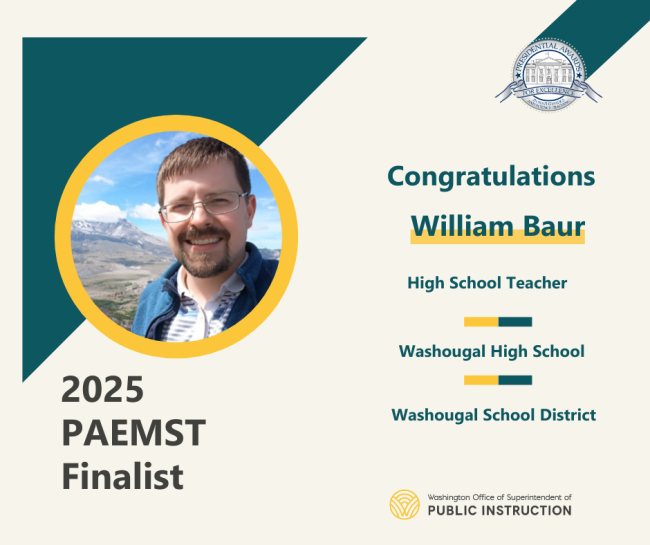
William Baur, a science teacher at Washougal High School in the Washougal School District.
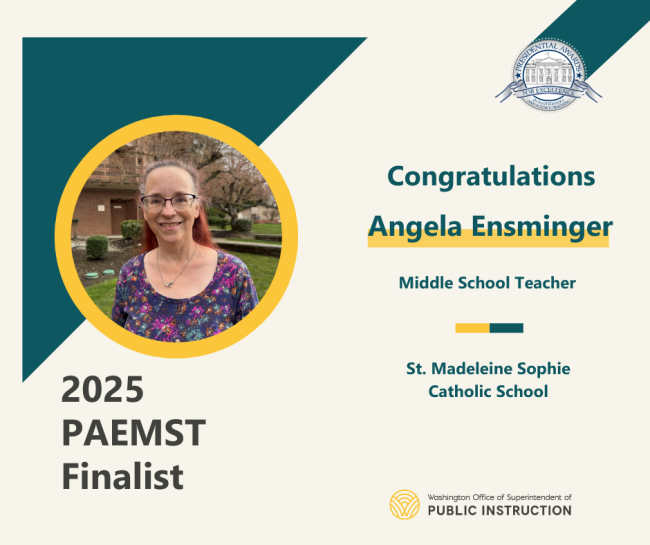
Angela Ensminger, a middle school teacher at St. Madeleine Sophie Catholic School.
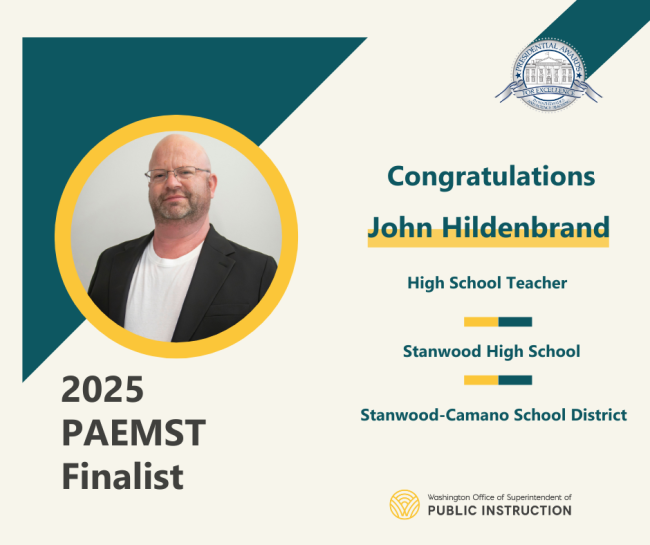
John Hildenbrand, a math teacher at Stanwood High School in the Stanwood-Camano School District.
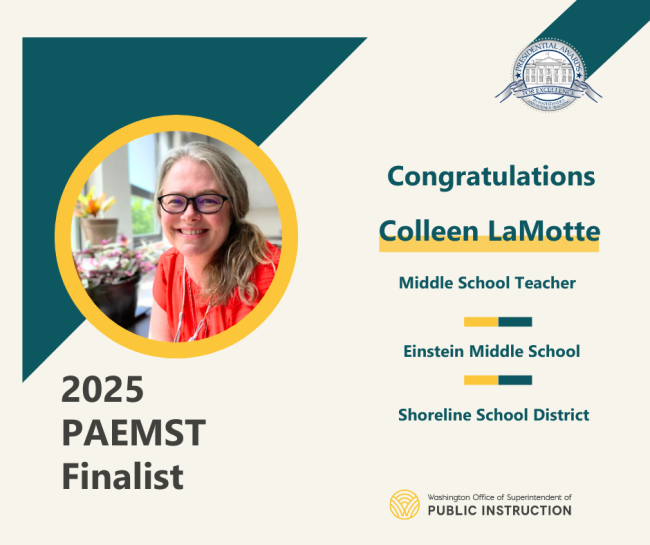
Colleen LaMotte, a science teacher at Einstein Middle School in the Shoreline School District.
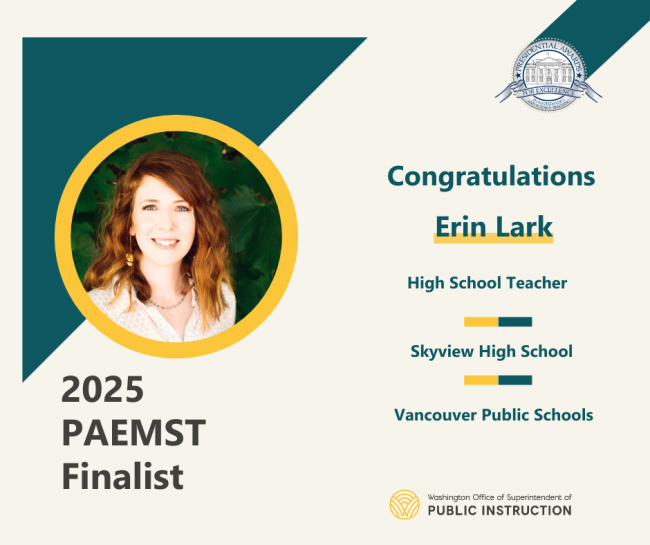
Erin Lark, a science teacher at Skyview High School with Vancouver Public Schools.
“I am incredibly proud of Washington’s five PAEMST finalists. With the ever-evolving advancements in science and technology, STEM is a steadily growing and fulfilling career pathway for many of our students,” said State Superintendent Chris Reykdal. “Additionally, the problem-solving and critical thinking skills developed in STEM classes are beneficial to all students, not just students with academic and career interests in STEM. At OSPI, we are grateful for the educators that have devoted their professional careers to teaching these valuable subjects and preparing our students for a diverse range of successful careers. Congratulations to our finalists!”
Finalists are selected by a statewide selection committee that includes classroom teachers, school district staff, subject matter experts, and other education partners. After being selected as state-level finalists, the national PAEMST committee will choose national awardees based on mastery of content, effective instructional approaches that support student learning, effective use of student assessment to guide learning, reflective practice and lifelong learning, and leadership and equity in education inside and outside of the classroom.
National awardees will be announced by the National Science Foundation and the White House at a later time. Previously, those selected as national awardees traveled to Washington, D.C., to attend a series of recognition events and professional learning experiences, receive a certificate signed by the President of the United States, and accept a $10,000 award from the National Science Foundation.
The President may recognize up to 110 teachers each year. Since the PAEMST program was first established by Congress in 1983, more than 100 Washington educators have earned the honor.
2025 PAEMST Profiles
- Colleen Lamotte
-
What has been your personal journey on the way to excellence in teaching math/science?
As a learner, I always wanted to understand why—not just memorize answers. That same curiosity drives my teaching: I want students to make sense of science, not just perform it. Over the years, I've shifted from delivering content to designing experiences that center student thinking, evidence-based reasoning, and productive struggle. Collaborating with colleagues, engaging in professional learning, and listening deeply to students have all shaped my practice. I've also worked to ensure every student sees themselves as capable of scientific thinking—especially those historically marginalized in STEM. Excellence, for me, is not about perfection, but about continuously refining my practice to support all students in becoming confident, critical thinkers.
What is one concept that excites your students and why?
My students are deeply curious about the world around them, and what excites them most is the chance to lift the veil on science—transforming their surroundings from something mysterious into something predictable, solvable, and within their reach. Whether they're exploring why some objects break in collisions while others bounce, how invisible magnetic forces work, or how traits are passed down through generations, students feel empowered when they can figure things out for themselves.
How do your lesson planning and teaching practices engage and support all students?
My lesson planning and teaching practices are grounded in the belief that all students bring diverse experiences, ways of thinking, and brilliance to the classroom—and that their ideas are essential to the learning process. I design lessons that position students as sense makers, not just receivers of information. Students engage in figuring out real phenomena, learning in community through structured talk, shared models, and opportunities to revise their thinking over time. This approach values multiple perspectives and supports different ways of expressing understanding. I build in time for noticing and wondering, which helps surface students' questions and connects science to their lives. I also use scaffolds, discussion routines, and formative assessment to ensure all students can access the work and grow from where they are.
How do the math and science concepts and skills you are teaching students help to prepare them for later learning, careers, and life?
The math and science concepts and skills I teach prepare students not only for future learning and careers, but for life. Scientific literacy is essential for making informed decisions—whether it's evaluating health claims, understanding environmental issues, or interpreting data in the news. But beyond content, students are learning how to think: to ask questions, analyze evidence, and reason through complex problems. These practices empower them to be critical consumers of information and active participants in their communities.
What can math and science teachers do to make those disciplines more culturally sustaining for students with diverse identities and experiences?
Math and science teachers can make these disciplines more culturally sustaining by recognizing and honoring the diverse identities, experiences, and ways of knowing that students bring to the classroom. Science and math are often seen as rigid or neutral, but in reality, they are human endeavors that thrive on creativity, curiosity, and collaboration. When we invite multiple perspectives and ways of thinking—including cultural, experiential, and historical knowledge—we enrich our understanding and become more likely to solve complex problems. I intentionally create space for students to share their own experiences and questions, connect science to their communities, and see themselves as valued contributors to knowledge-making.
What advice would you give to parents, families, or caregivers who want to support their students’ math and science learning?
I would encourage families to support their student’s math and science learning by nurturing curiosity at home. Ask them what they're wondering about, and invite them to explain their thinking—even if the answer isn't clear yet. Encourage them to take academic risks, explore ideas, and be okay with not knowing right away. One of the most powerful messages families can give is that learning is a process: it's okay to make mistakes, change your mind with new information, and keep trying.
- Angela Ensminger
-
What has been your personal journey on the way to excellence in teaching math/science?
I have always wanted to be a teacher. I pursued my passion by earning a Bachelor of Science. in Mathematics from Loyola University in New Orleans and began teaching my own classes. After moving to Texas, I completed an M.S. in Mathematics with a specialization in statistics at the University of Texas at Dallas, where I also taught calculus and statistics to undergraduates. This experience deepened my understanding of the interconnectedness of mathematical fields—an insight I strive to impart to my students today. Later, after relocating to Washington state, I earned my teaching license and played a key role in founding St. Madeleine Sophie, a school committed to inclusivity for all students, regardless of economic, social, or educational background.
What is one concept that excites your students and why?
My students love connecting math concepts to technology. In geometry, they used Tinkercad to code and design objects that demonstrated geometric transformations, which they then brought to life using our 3D printer. Similarly, seventh-grade students built robots to apply their understanding of surface area and volume. These hands-on activities help students see the real-world applications of math and make the subject more engaging and meaningful. In addition, I run a recess robotics program for students in grades 5–8. In the fall, we partner with Special Olympics Washington to compete in Unified Robotics, where students with intellectual disabilities collaborate with their peers to build and program a robot.
How do your lesson planning and teaching practices engage and support all students?
Our school serves a diverse range of learners, from high-achieving students who need continual challenges to those who require accommodations and modifications to succeed. With my background in teaching through the college level, I have a broad perspective on how mathematical concepts evolve in later courses, allowing me to guide advanced students toward deeper exploration. At the same time, I ensure that students who need support have access to lessons that are both engaging and accessible. I prioritize inclusive teaching strategies, such as using low-floor, high-ceiling tasks that allow every student to participate meaningfully. By designing lessons that encourage exploration and multiple entry points, I create a learning environment where all students can thrive.
How do the math and science concepts and skills you are teaching students help to prepare them for later learning, careers, and life?
One of the most important things I hope my students take away from their math classes is the ability to persevere through challenges and apply logical, critical thinking to solve problems. While they may not remember every formula or specific skill later in life, the habits of mind they develop—reasoning, analyzing, and problem-solving—are transferable to all areas of learning, future careers, and everyday decision-making. These foundational thinking skills are what truly prepare them for success beyond the classroom.
What can math and science teachers do to make those disciplines more culturally sustaining for students with diverse identities and experiences?
Teachers must begin by truly getting to know their students, their identities, communities, and what matters most to them. Building authentic relationships allows students to feel seen, heard, and valued in the classroom. Teachers should model what it means to be lifelong learners by being open to learning from their students and embracing the diverse perspectives they bring. By asking questions, listening deeply, and showing genuine interest in each student as a whole person, educators can create a more inclusive and responsive learning environment.
What advice would you give to parents, families, or caregivers who want to support their students’ math and science learning?
From an early age, model a love for math and science learning with your children. Read books together, play games that involve numbers or strategy, and take walks where you look for patterns in nature. Show curiosity about how the world works—your wonder and enthusiasm will be contagious! Encourage your child to ask questions, explore, and take risks in their thinking. Remember, your attitudes toward learning deeply influence theirs.
- John Hildenbrand
-
What has been your personal journey on the way to excellence in teaching math/science?
My journey into teaching started long before my first job. In 7th grade, a teacher recognized my strength in math and encouraged me. Later, in high school, another teacher made math engaging and relevant, reinforcing my passion. My mom, also a teacher, set an incredible example. Looking back, I've always known I was meant to be a math teacher. Every experience—from my days as a student to my time teaching in the classroom—has only strengthened that belief.
Teaching across four states and multiple districts has given me a diverse perspective on education. Each experience has shaped my understanding of how students learn and what truly works in the classroom. These experiences have also pushed me to explore new strategies to make learning more meaningful. About 15 years ago, a colleague introduced me to student-led investigative learning, and it completely transformed my approach. Seeing students take ownership of their learning and engage deeply with the material was a turning point for me.
What is one concept that excites your students and why?
One concept that really excites my students is exploring the relationship between exponential functions and logarithms. There's something about seeing how these two ideas connect that just clicks for them, and their excitement fuels my own passion for teaching. A highlight of our exploration is a multi-day project on the water hyacinth plant. Students examine its rapid growth, linking it to exponential and logarithmic functions. What makes this project even more engaging is its integration with biology, showing students how math isn't just abstract but a powerful tool to understand the world. The best part is that this project often sparks curiosity beyond the classroom. I've had students ask for more information about STEM fields and even take the initiative to explore them on their own.
How do your lesson planning and teaching practices engage and support all students?
When planning lessons, I focus on student collaboration, ensuring that all students have opportunities to share their perspectives and learn from one another. I strive to create a classroom environment where students feel comfortable taking academic risks, knowing their ideas are valued and that mistakes are part of the learning process. A key part of my teaching is movement and active engagement. Whether through group problem-solving, interactive activities, or discussions with different classmates, movement helps keep students energized and involved. I also use multiple representations such as manipulatives, group vertical whiteboards, and technology to address students' diverse backgrounds, knowledge, and experiences. To ensure all students succeed, I differentiate instruction by providing scaffolding for those who need extra support while offering enrichment for students ready for more challenges. Creating a dynamic, inclusive learning environment not only makes lessons more engaging but also builds students' confidence in their thinking.
How do the math and science concepts and skills you are teaching students help to prepare them for later learning, careers, and life?
Students need to see the importance of every concept they learn. I want them to recognize how each idea connects to what they've learned before and how it builds toward what's coming next. When students see these connections, we can move past the question, "When will we ever use this?" and instead focus on how math is woven into everything around us. I like to think of learning like music: You don't just hear a single note; you experience the whole song. Math, like music, is all about patterns, relationships, and connections. Every concept adds another layer to the bigger picture. Beyond the classroom, math and science build critical thinking, problem-solving, and analytical skills that prepare students for a range of careers—some of which don't yet exist.
What can math and science teachers do to make those disciplines more culturally sustaining for students with diverse identities and experiences?
Connecting learning to students' experiences is essential. By analyzing local data—such as the cost of goods, population changes, or environmental factors—students can apply math to real-world issues that directly affect their communities. Representing this data in various ways and predicting trends allows students to take ownership of their learning and see it active in their own lives. Collaboration is also important. I encourage students to work together on algebraic problems, share strategies, and learn from one another. These discussions create a sense of community, helping students recognize that multiple approaches can lead to understanding.
What advice would you give to parents, families, or caregivers who want to support their students’ math and science learning?
One key message to reinforce is that effort is more important than always getting the right answer. Encouraging a growth mindset, where mistakes are seen as valuable learning opportunities, helps students build resilience and avoid frustration. Talking positively about math at home is essential. Instead of focusing on past struggles, parents can highlight math's usefulness in everyday life—like measuring ingredients, budgeting, or strategizing in games. Parents can also motivate students by discussing how math connects to various careers, from engineering to creative fields like architecture. Showing the wide range of possibilities can spark students' interest in the subject. Finally, maintaining open communication with teachers is key. Parents should feel comfortable discussing their child's progress, asking about areas of struggle, and seeking additional resources.
- William Baur
-
What has been your personal journey on the way to excellence in teaching math/science?
My parents, grandparents, cousins, uncles, and aunts were my first science teachers and inspired my interest in the subject at a young age. As a first-year science teacher I was fortunate to be paired with an excellent mentor teacher: John Hoover. For six school years, we taught eighth grade together at Stewart Middle School in Tacoma. I learned from him the importance of bringing creativity, problem-solving, and real-world scenarios to science instruction. Collaborating with John Hoover helped build my confidence as a young teacher working under challenging circumstances. Since relocating to Clark County, my teaching journey has been shaped by my involvement in the OpenSciEd project as a field test teacher, professional learning facilitator, and curriculum writer. Through this project, I have been able to collaborate and learn with science educators from across the country.
What is one concept that excites your students and why?
This year for my HS biology class, I co-wrote and taught a unit about metabolism, carbohydrates, fats, and proteins centered around the question "How do we design a better school lunch to meet the nutritional needs of all students?" Throughout the unit, students learned about the nutritional needs of our body, feedback loops to maintain blood sugar levels, changing dietary guidelines and restrictions from the U.S. Department of Agriculture, and different types of fats and protein sources. At the end of the unit, the Washougal School District chef shared all the planning and work that goes into their daily school meals and my students got to ask him questions.
How do your lesson planning and teaching practices engage and support all students?
When selecting units to teach, I look for a phenomenon that is relevant to teenagers. The unit where students learn about Newton's Second Law is focused on explaining the phenomenon of car crashes becoming more common, but less deadly. The unit where students learn about electromagnetic waves is focused around how microwave ovens and cell phones work. This gives all students a starting place to engage in the topic. I start each unit by having students brainstorm questions they have about the topic, and then ideas they have for investigations and experiments.
How do the math and science concepts and skills you are teaching students help to prepare them for later learning, careers, and life?
I am teaching my students how to ask questions, collect and analyze data, and support their arguments with evidence. All these skills will prepare them for success. For each unit I teach, I recruit a local guest speaker from the school or community to share how their career relates to what we are learning in science class. Students also ask the guest speaker questions they brainstormed at the start of the unit. In the past few years, my class guest speakers have included breast cancer survivors, a healthcare navigator, a retired electrical engineer, the school cafeteria chef, and the CEO of the Port of Camas-Washougal.
What can math and science teachers do to make those disciplines more culturally sustaining for students with diverse identities and experiences?
I learn something new each time by listening to students sharing what they know. Or their questions make me motivated to learn more or bring in a guest speaker with a new perspective we hadn't considered before. When I field tested the cancer unit, my students learned why older people are at risk of cancer. However, they were curious about how a younger person could get cancer, but the experience of a young person diagnosed with cancer wasn't represented in the first draft of the curriculum. Later as a member of the cancer unit revision team at CU Boulder, I interviewed two young women, Lauren from Miami and Lakita from Kenya who have, a rare inherited genetic disorder that led them to have multiple bouts of cancer before they were teenagers. In the revised OpenSciEd HS biology cancer students watch interviews of Lauren and Lakita to learn how their cancer was treated, and how their family and loved ones supported them through their medical traumas.
What advice would you give to parents, families, or caregivers who want to support their students’ math and science learning?
Parents, families, and caregivers can support their students' learning in science by exploring the outdoors together. For HS age students, parents and guardians can encourage them to find a STEM related after school activity.
- Erin Lark
-
What has been your personal journey on the way to excellence in teaching math/science?
Two shifts transformed my teaching over time. First, I moved from delivering content to cultivating curiosity. I encourage questions over answers, process over perfection. My classroom is a space of creativity and critical thinking, where challenges are an expectation, failure is a stepping stone, and relevance is at the heart of our work. Second, I teach civic engagement in science class. It's not enough for students to learn about their world, they need to learn what they can do next. Armed with science concepts, skills, and processes, students can advocate for a future they want, whether their career path is within science or beyond. Because that's the magic of science learning—it's not just about life as it is, but the world student can help build.
What is one concept that excites your students and why?
One concept that truly excites my biology students is CRISPR and gene editing. It's not just cutting-edge science—it feels like something out of science fiction—only it's real. When students learn that we can potentially cure genetic diseases, engineer disease-resistant crops, or even bring back extinct species like the return of dire wolves, their curiosity lights up. It shifts biology from something you study to something you use. Most of all, CRISPR gives students a sense of agency. They see biology not just as facts in a textbook, but as a powerful tool that could solve real problems. It makes them ask: "What role could I play in this future?" And that's when the real learning begins.
How do your lesson planning and teaching practices engage and support all students?
Crafting a unit is like baking a cake. For the layers, I'm all about hands-on, inquiry-driven learning. Students experiment, explore, and ask their own questions. Whether designing a model, diving into a virtual lab, or analyzing real data, I want them to do science. I use a mix of strategies to meet students where they are—group work, tech tools, language-centered tasks—and offer flexible ways to show what they know. Regular check-ins help me adjust and support with a little extra or a different approach. My favorite way to frost the cake is to level up on relevance. Whether checking TikTok, CNN, or asking directly, I look for content that has students buzzing. I teach science standards through the lens of what students care about now—be it social justice, short-form videos, or both. More than anything, I try to create a space where students feel safe to take risks, be curious, and grow.
How do the math and science concepts and skills you are teaching students help to prepare them for later learning, careers, and life?
I focus on helping students build the skills they need for future careers and to make a real impact. In class, we practice critical thinking, problem-solving, and teamwork—skills essential for careers in fields such as tech, healthcare, and engineering, as well as for tackling everyday challenges with authenticity. Students might design their own renewable energy solutions, use data to understand climate change, or investigate how tech impacts our daily lives. Projects like analyzing local water quality and presenting solutions to the community or collaborating on how to reduce waste in their school give students experience in a trajectory of positive impact. They learn how science influences public policy, from environmental laws to healthcare decisions, and how they can contribute in ways that will mold their future. By blending science with civic engagement, students not only learn core concepts through doing science—they become informed, active citizens who can speak up, solve problems, and drive the change they want for their future.
What can math and science teachers do to make those disciplines more culturally sustaining for students with diverse identities and experiences?
As educators, our goal isn't just to teach content, but to make math and science relevant and meaningful for every student in our classrooms. To do that, we need to ensure all students see themselves in the work we do together. Teachers can highlight pioneers in the fields of math and science that represent their students and highlight contributions of students' heroes. We can also connect our content to students' communities, whether through discussing local environmental issues in ecology or using math to explore real-world topics like healthcare, we make the subjects feel relevant to students' lives. Using relevant teaching methods is key, whether including new approaches to math or examining indigenous knowledge in science, we must value student experiences, interests, and values.
What advice would you give to parents, families, or caregivers who want to support their students’ math and science learning?
You don't need to be an expert—you just need to nurture their learning. Start by encouraging questions. Next, promote a growth mindset. Remind your child that it's okay to struggle, mistakes are part of learning. Praise effort and persistence, not just correct answers. Create hands-on learning opportunities: cook together and talk about measurements, play math games, or bring them in to help as you solve problems around your home. Stay engaged by asking about what they're learning in school, attend community events that celebrate or showcase STEM, and stay connected with teachers. Finally, make real-life connections. Talk about how math and science show up in everyday life—weather, technology, nature, or even your job. When students see that their families value these subjects, it boosts their confidence and motivation. With your support, our future leaders will stay curious and change the world.