
Media Contact
Katy Payne she/her
360-764-0201
As the Legislature takes steps to balance the state budget, budget writers and the Governor have both considered reducing student access to the Transition to Kindergarten (TK) program. New data show that former TK students continue to outperform their peers when they enter kindergarten.
OLYMPIA––February 19, 2026––New statewide data show that Washington’s Transition to Kindergarten (TK) program is helping more children start school ready to succeed, contributing to record-high kindergarten readiness across the state.
Transition to Kindergarten (TK) is a legislatively authorized program for children who are at least 4 years old by August 31 and who, through a screening process, are identified as needing additional preparation to be successful in kindergarten the following school year. TK provides an early learning bridge for families across Washington, including many who do not qualify for other state-funded preschool programs.
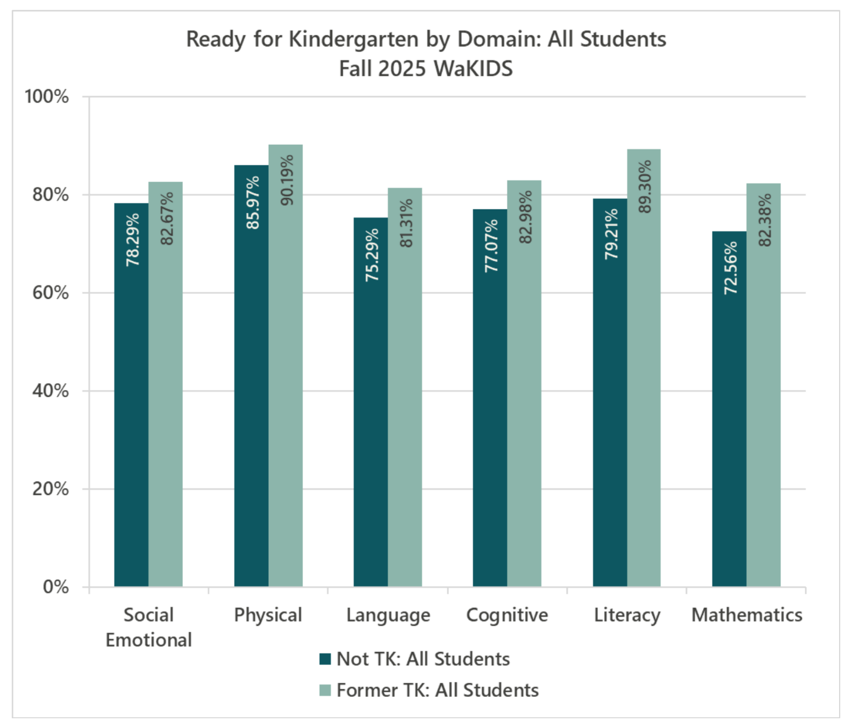
In Washington, all incoming kindergarten students are assessed through the Washington Kindergarten Inventory of Developing Skills (WaKIDS), which measures readiness across six developmental domains: cognitive, language, literacy, mathematics, physical, and social-emotional development.
In fall 2025, 55.3% of all incoming kindergarten students were ready in all six areas, a record high for the state. Even more promising, students who previously attended TK outperformed their peers, with 64.46% of former TK students ready in all six domains compared to 54.48% of non-TK students. That 10-percentage-point difference underscores the impact of early learning access through TK.
“The results are clear,” said State Superintendent Chris Reykdal. “Students who attend TK are more prepared for success on day one of kindergarten. That stronger start matters––not just for individual students, but for the long-term success of our entire education system.”
Kindergarten readiness is a strong predictor of later academic success. However, despite the importance of early learning, access remains limited. Only 24% of Washington’s 3- and 4-year-olds are enrolled in state-funded preschool, ranking the state 33rd nationally for access for 4-year-olds. TK plays an important role within Washington’s early learning system, alongside the Early Childhood Education and Assistance Program (ECEAP), Head Start, and community-based programs.
Unlike some programs, TK was intentionally designed to be accessible to any student who needed additional support before kindergarten, regardless of their family’s socioeconomic status. While income-qualified programs remain critical, TK was created to expand access and support children from a range of socioeconomic backgrounds in learning together. In the current school year, the income demographics of TK students mirrors the rest of the K–12 system, with nearly 50% identified as low-income.
“Our public schools bring students from all backgrounds together to learn side by side, and that should start before kindergarten,” Reykdal said. “Young children benefit from learning in mixed-income environments. TK was designed to reduce economic segmentation, not reinforce it.”
This legislative session, both the Governor and the Legislature have put forward proposals that would reduce student access to TK, either by reducing the total number of students to be served or by limiting enrollment to students identified as low-income or students with disabilities. One current proposal would immediately reduce the number of TK students by more than a quarter of total program enrollment (1,800 students).
The Office of Superintendent of Public Instruction continues to strongly oppose proposals that would reduce access to TK. Participation in TK is an effective strategy for closing opportunity gaps and ensuring children across Washington enter kindergarten ready to learn, and data show that to be true year after year.
“Reducing access to TK would move us in the wrong direction,” Reykdal said. “When the evidence shows a program is working, especially for students who need the strongest start, we should be strengthening it, not limiting it.”
For More Information
- Kindergarten Readiness data are available for the state as well as by school and school district on the Washington State Report Card. Users can also download data files from the Report Card if they are interested in more detail.
- Transition to Kindergarten: A Proven Strategy for Closing Opportunity Gaps (OSPI Document)
- TK District Landscape Survey Report with Testimonials (OSPI Document)
- TK Map showing which schools have TK programs, with headcounts of TK students (OSPI Map)
- Overview | Transitional Kindergarten (OSPI Video)
- Strategies to Foster Integration in Early Childhood Education (Learning Policy Institute Report)