
Media Contact
Katy Payne she/her
360-764-0201
Yesterday, leadership in the State House and Senate released their 2026 budget proposals. Below is State Superintendent Chris Reykdal’s statement.
OLYMPIA—February 23, 2026—The House and Senate have released their 2026 budget proposals. Despite the state’s continued underfunding of public education, both proposals double down on Governor Ferguson’s recommended cuts to education.
With significant cuts to early learning, dual credit, and the ability for communities with lower property values to provide students with supplemental learning supports, these budgets continue a disturbing trend of cutting the K–12 system to balance the state budget. Further, they make substantial cuts to higher education, starving students of future opportunities.
While the budget proposals would devastate critical education programs with a direct impact on students and families, they add billions in new investments across other sectors. This isn’t a question about whether the resources are available; it’s a question about the priorities of the Governor and the Democratic legislative majorities.
The Washington State Constitution is explicit that “making ample provision for the education of all children” is our state’s paramount duty (Article IX, Sec. 1).
Budgets are a statement of values. While the Governor and nearly all legislators committed to supporting our public schools when they ran for office, those values are not reflected in these budget proposals.
The resistance to fully fund our education system isn’t limited to the current budget shortfall. Over the last three biennial budgets, the share of the state budget dedicated to K–12 education has dropped from a peak of 51.6% in 2019–21 (right after our State Supreme Court mandated ample funding) to 42.4% in the House’s current proposal and 42.2% in the Senate’s.
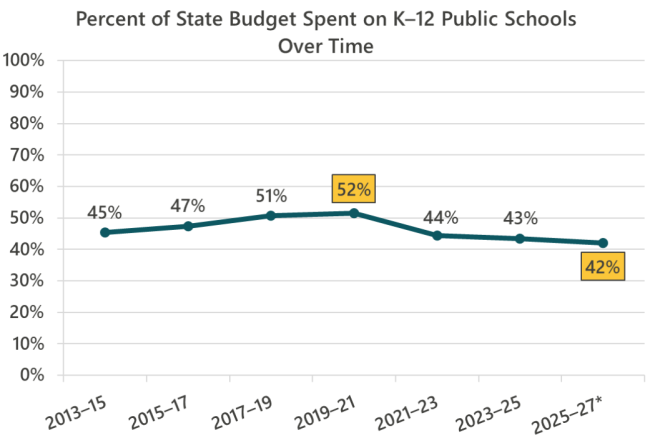
Recent history shows us that the only way the Legislature meets its constitutional obligation to fully fund K–12 education is through litigation, and now we are headed in that same direction once again.
Across the United States, nearly 90% of young people receive their K–12 education in a public school. The vast majority of parents and families send their children to school each day expecting that their child will have access to relevant and engaging curriculum, experienced and licensed educators, supplemental instruction when needed, nutritious meals, and course options that align with their child’s future goals.
The ability of our public school system to meet those expectations is directly dependent upon the Legislature’s commitment to provide the resources.
While legislative leaders came out three weeks ago with a proposal to collect new revenue through a “millionaires tax,” they have declined to make explicit commitments for how the new revenue will, or will not, support our public schools. (I proposed that the revenue support the middle class by fully funding basic education, school meals, dual credit, free college, and providing a property tax break for homeowners.)
With so much talk of additional revenue, but zero commitment at this point to fund education with additional dollars, voters must wonder when education will be prioritized by the current governor and the current legislative majorities.
Just two weeks ago, 95% of school levies on the ballot across the state passed, sending a strong message that Washington voters overwhelmingly support their local public schools. While the state’s level of funding has declined over the last seven years, voters have seen levies that they approved for enrichment (additional staffing support, mental health, athletics, technology, and more) be redirected to pay for the basics out of necessity. Schools can’t pay for tutoring when they are choosing between that and paying their electric bill.
These budget proposals need significant changes before they are voted on. I can only hope that the House, the Senate, and the Governor will rethink their cuts to education and make definitive commitments in the short- and long-term to K–12 education, higher education, and early learning.